Sustainability is not a constraint. It is how strategy gets redefined.
A practical framework for leaders who need to turn sustainability from pressure, reporting and risk into strategy, resilience and value creation — in a world of climate, energy, nature, AI, and social disruption.
Purpose-Led StrategyPlanetary BoundariesStakeholder CompassDouble MaterialityValue Beyond MetricsResilience & AdaptabilityTheory of ChangeEnvironmental FootprintAI & SustainabilityTrue ImpactCSRD & RegulationRegenerative Business
The Shift Required
The old playbook is not enough anymore.
Most sustainability programs were designed for a stable world. We are not in that world anymore.
Climate shocks, energy volatility, biodiversity collapse, AI disruption, and social fragmentation are not isolated risks to manage on the side — they are the new operating environment. The question is no longer whether to act. It is whether your organisation is designed to create value inside these new boundaries, or despite them.
This book is not about reporting. It is about strategy. About building organisations that are strong enough, purposeful enough, and adaptive enough to grow in a world that has permanently changed.
Sustainability as compliance→Sustainability as strategy
Reporting on ESG→Designing for impact
Risk management→Resilience & value creation
Shareholders only→Multi-stakeholder alignment
Short-term extraction→Long-term regeneration
Doing less harm→Creating net-positive good
"Sustainability is not a definition to memorise. It is a process to practise."
An operating system for how organisations interpret reality, make decisions, allocate capital, and evolve over time — coherent with ecological limits and human flourishing.
The Framework
Seven interconnected principles — one integrated system
The Seven Principles are not a checklist. They are a system. Each principle reinforces the others. Purpose without measured footprint remains aspirational. Resilience without stakeholder alignment remains brittle. Impact without holistic value measurement remains unverifiable.
Together, they form a complete operating system for sustainable value creation.
P1 · Purpose Aligned with Impact
P2 · Growth within Planetary Boundaries
P3 · Stakeholder Alignment
P4 · Environmental Footprint
P5 · Value Beyond Metrics
P6 · Resilience & Adaptability
P7 · True Impact
Seven Principles
A Complete Operating System for Sustainable Value Creation
Each principle is a chapter, a set of frameworks, and a set of real-world cases. Click any principle to go deeper.
Where does your organisation stand on the Seven Principles?
The Seven Principles Diagnostic is a short self-assessment that reveals how your organisation behaves across the Seven Principles, and where the largest gaps between ambition and reality may exist.
Designed for executives, boards, and leadership teams to start the sustainability strategy conversation grounded in reality, not aspiration.
15-minute self-assessment
Personalised PDF report
Designed to provoke a leadership conversation
The assessment is not a certification or an ESG rating. It is a mirror designed to help leaders think differently about sustainable business.
Get the Seven Principles Diagnostic
Free for leaders and their teams.
No spam. Unsubscribe any time.
Frameworks & Tools
The Reference Library
Every principle is backed by concrete tools, frameworks, and visual models you can use with your team today. Eight are finished and downloadable — free to subscribers.
Principle 1 · Purpose
The Purpose-to-System Canvas
The gap is never between the statement and the intention — it is between the statement and the operating system. Tests your purpose against governance, incentives, strategy, products and capital allocation.
Five tests that translate planetary science into a decision. There is no score — ecological thresholds do not average out. Every material failure forces an explicit choice, with a name against it.
Not a business model canvas. It follows the revenue back to the planet — through resources consumed and boundaries pushed — and asks what the growth actually leaves behind.
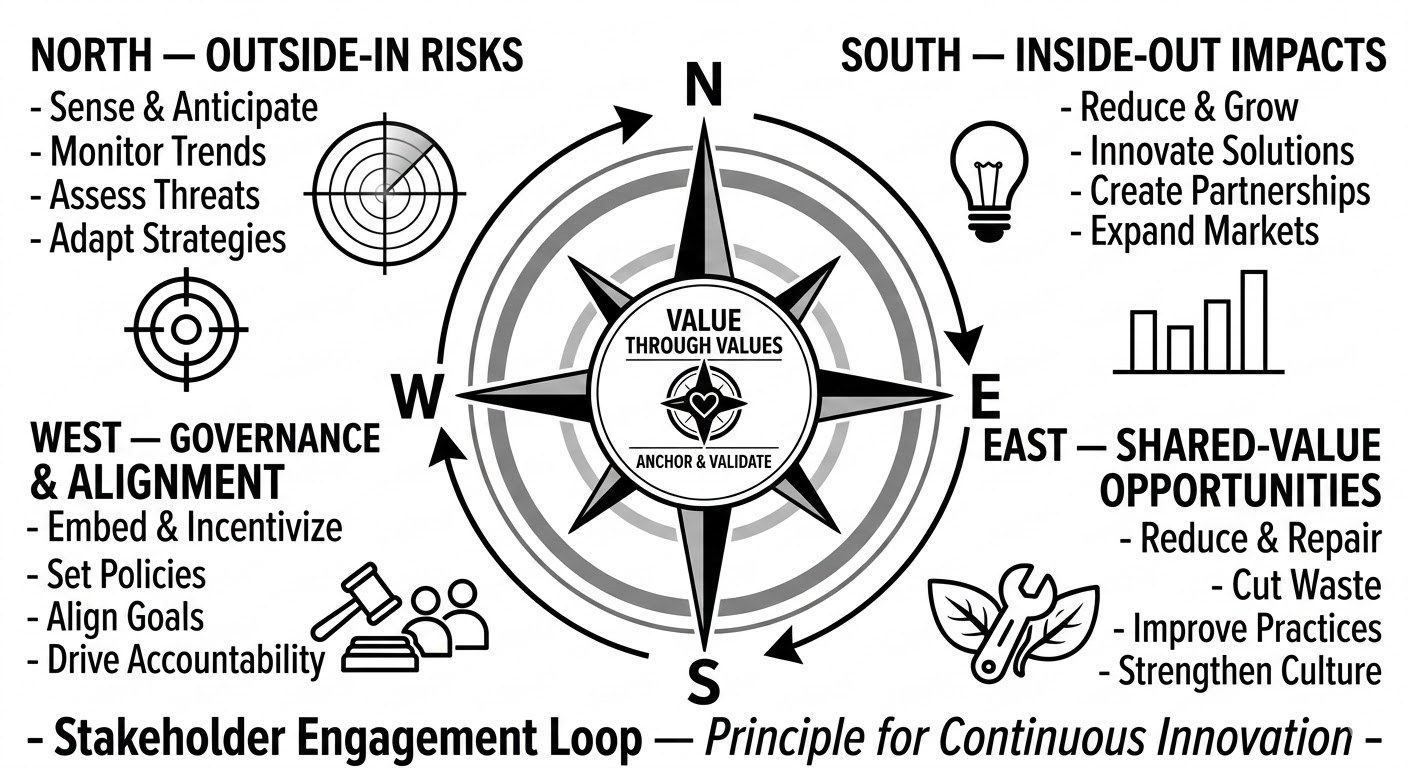
Not a checklist — a learning loop. Four sweeps (outside-in risks, inside-out impacts, shared value, governance) around one centre: the value you create, and the three metrics that verify it.
Put a number on the externality. Not to pay it — to see which decisions would change if you had to. Includes valuation notes on which unit costs are defensible, and what should never be monetised.
The Sustainable Value Creation Canvas. Profit may still appear while it is being drawn from the depletion of another capital. Six capitals, each scored on what you draw and what you return.
Run strategy when the future cannot be forecast. Three routes, pre-agreed triggers, and decisions made before the shock arrives — with no-regret moves, an options budget, and stop rules agreed now.
Resilience is the management of dependencies. If you do not know yours, you are not managing risk — you are managing illusion. Sweeps eight dependency types, from natural thresholds to critical people.
Design your organisation's purpose statement, align it with positive impact, and hardwire it into governance, incentives, and decision-making. The input the Purpose-to-System Canvas tests.
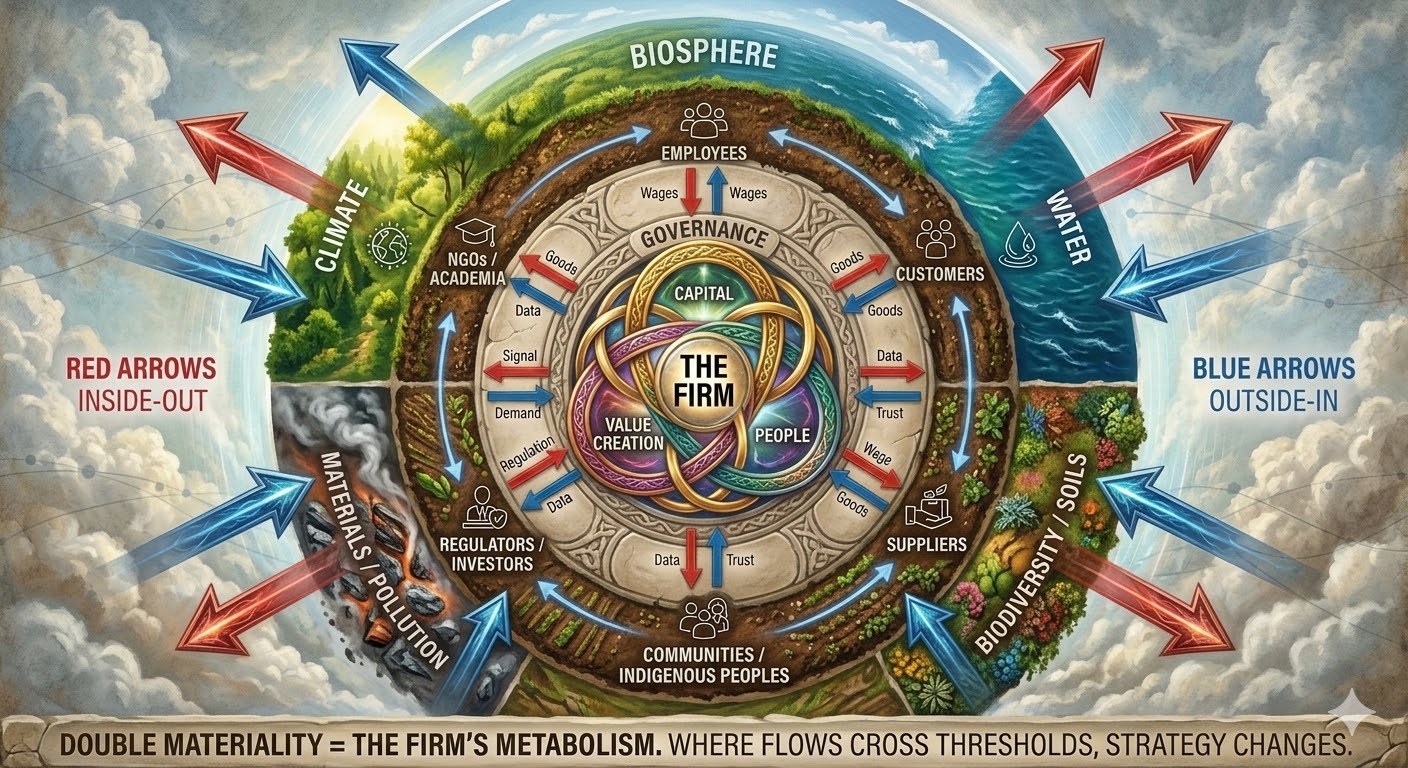
The diagnostic lens linking financial impacts and risks to the company's environmental and social footprint — required under CSRD and foundational to any serious sustainability strategy.
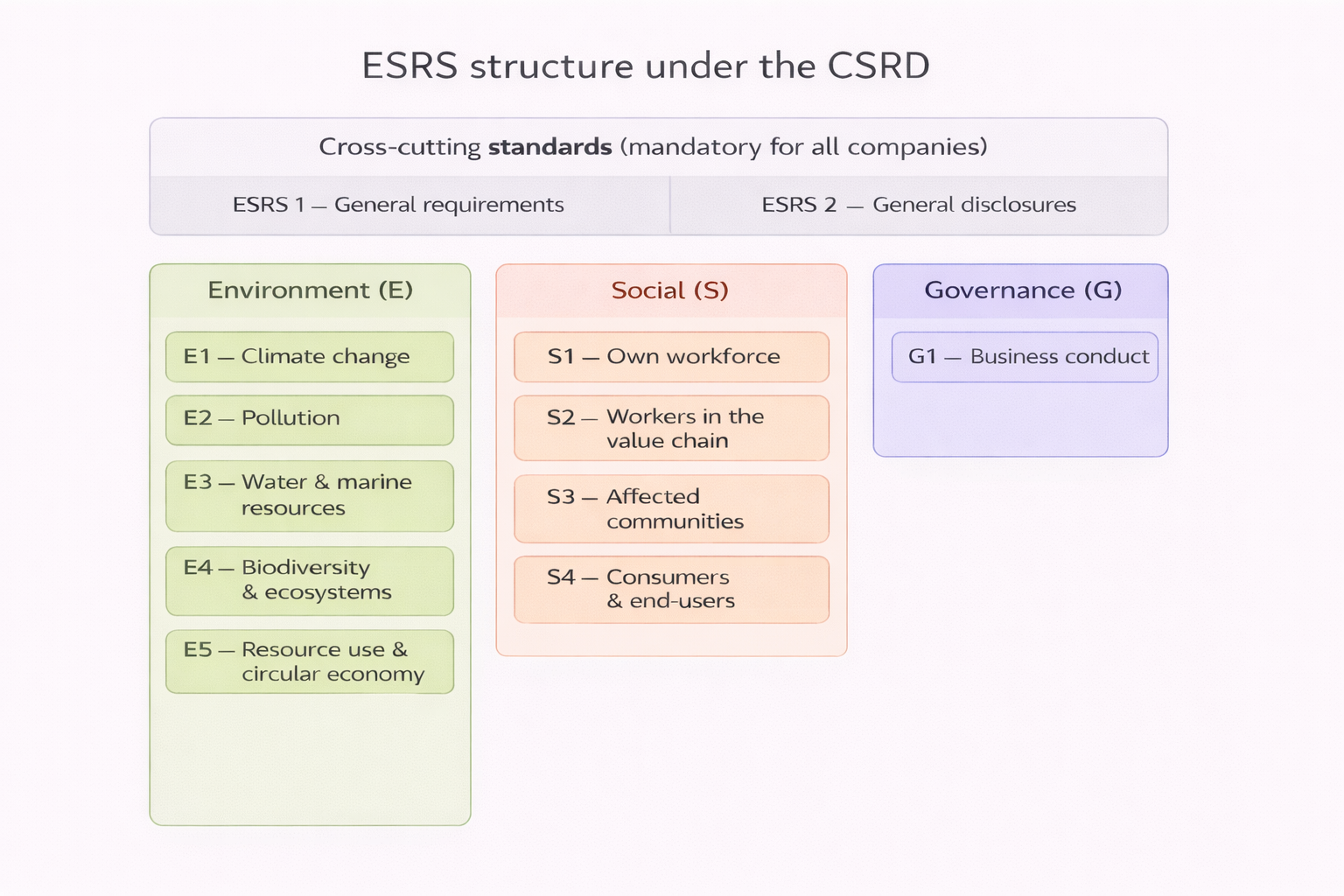
A practical guide to the Corporate Sustainability Reporting Directive — what it requires, which companies it covers, and how to use it as a strategic opportunity.
40+ organisations featured across the Seven Principles
From global multinationals to purpose-driven challengers — real cases of how these principles have been applied in practice, across sectors and geographies.
Case study documentedModel diagnosisReferenced in book
Too often, sustainability experts become cynical — seeing only limits, only decline, only collapse. This book takes a different stand. Chapter 10 is written for leaders who feel stuck between restriction and possibility, and choose to be on the side of progress.
The Solvers
Think in systems. Analyse deeply. Search for coherence before acting. They see what should not be built — and why. They bring depth, anticipation, responsibility.
Sustainable leadership
⟷
Between urgency and humility. Between innovation and ethics. Between progress and consequence.
The Builders
Move fast. Test, ship, and make things real. They accept constraints — but without purpose, momentum becomes extraction. They bring energy and execution.
AI as Leverage Point
AI operates at the most powerful leverage points in any system: information flows and purpose. It processes signals no human can handle, detects hidden patterns, and makes consequences visible — sharpening judgment, not replacing it.
From Reporting to Transformation
ESG dashboards describe the past. AI-enabled systems can now anticipate, simulate, and influence outcomes — shifting from retrospective KPIs and manual data entry to real-time, forward-looking decision support rooted in satellite and operational data.
Planetary Intelligence
Digital twins of ecosystems, cities, and supply chains let leaders test decisions before they become irreversible. Initiatives like NVIDIA's Earth-2 and Europe's Destination Earth are shifting governance from crisis management to anticipation.
Regenerative by Design
We are entering a fifth technological era — not more efficiency, but intelligent balance. Systems designed not to maximize output, but to maintain equilibrium: learning, adapting, and regenerating the conditions that allow them to exist.
"The sustainable companies of the future will not be defined by restriction alone. They will be defined by intelligent creativity."
— Arnaud Blandin, Chapter 10
The Weekly Dispatch
Ideas for leaders who take sustainability seriously
One insight per week. A framework, a case study, a question worth sitting with. Built for executives, board members, and strategy teams navigating the new operating environment.
Join leaders from across sectors. By subscribing you agree to receive the Weekly Dispatch by email. No spam. Unsubscribe any time.
What Leaders Say
Built for people who need to act, not just understand
"
What I appreciate most about Arnaud Blandin is how he cuts through the noise and helps people truly grasp what's at stake—the challenges, the complexities, and also the many opportunities that sustainability offers.
PL
Patrizia Luchetta
Non-executive Director, Eurofins
"
Arnaud's strength lies in integrating sustainability, innovation and data driven decision making into the core strategy of companies. I continue to be impressed by his passion for Corporate Purpose and Sustainable development, clarity of thought, quiet leadership, and ability to turn vision into action.
JB
Jayanth Bhuvaraghan
Board Member, Senior Advisor
"
One of the few sustainability experts that I know who is able to marry AI, data analytics and a deep understanding of sustainability, sustainability reporting, leadership and human dynamics. I highly recommend him for ExCo and board briefings and coaching on those topics!
FB
François Bogacz
Leadership Development Strategist
"
Arnaud has given me the new perspective on sustainability and how AI can help us navigate the complexity from ideation and beyond. I will recommend this to my peers 100%.
JC
Joyce Chan
Industrial General Manager, Cummins
AB
Program Director CEDEP 500+ executives/yr
About the Author
Arnaud Blandin
Arnaud Blandin works with organisations that are ready to move beyond sustainability as a reporting exercise and use AI, data, and impact intelligence to redesign how value is created in the first place.
With more than 20 years of global experience across Fortune 500 corporations, private equity funds, family offices, and high-growth ventures, his work sits at the intersection of strategy, sustainability, artificial intelligence, and capital allocation.
He began his career as an engineer in Silicon Valley, contributing to Java language standards and building enterprise systems for organisations including NASA. He later scaled technology and intelligence businesses across Asia, Europe, and North America. Today he is CEO of Vela Intelligence and founder of the Institute for Responsible Innovation and Sustainability (IRIS).
Alongside his advisory work, Arnaud is programme director for Sustainable Value Creation at CEDEP, adjunct professor at Singapore Management University, SKEMA, IUM, and EDHEC where he teaches and mentors more than 500 executives and directors. He is also a frequent speaker at other global education platforms.
Apply the Seven Principles through executive education
Arnaud Blandin is Programme Director of the Sustainable Value Creation programme at CEDEP. The programme brings together sustainability strategy, systems thinking, AI-enabled diagnostics and practical frameworks to help senior leaders turn sustainability challenges into business transformation, resilience and measurable value creation.
Participants apply these approaches to a real organisational challenge and leave with a decision-ready action plan for their organisation.
Sustainability Strategy · Systems Thinking · AI-Enabled Transformation
Speaking & Workshops
Bring the Seven Principles to your organisation
Board retreats, leadership offsites, executive education programmes, and keynotes — designed to move teams from understanding to action. Every engagement is tailored to your sector, regulatory environment, sustainability maturity, and strategic priorities.